Qijing GX7 Opens Pre-Sales: Can GAC and Huawei's Family SUV Fix What the EV Startups Missed?
The GAC-Huawei brand's second model, an extended-range five-seater priced at 249,900-311,900 yuan, bets on fully flat rear seats, a HarmonyOS-managed cabin and Qiankun ADS 5 to take on the Li Auto L8 and AITO M7.
2026-09-15
Wikimedia Commons
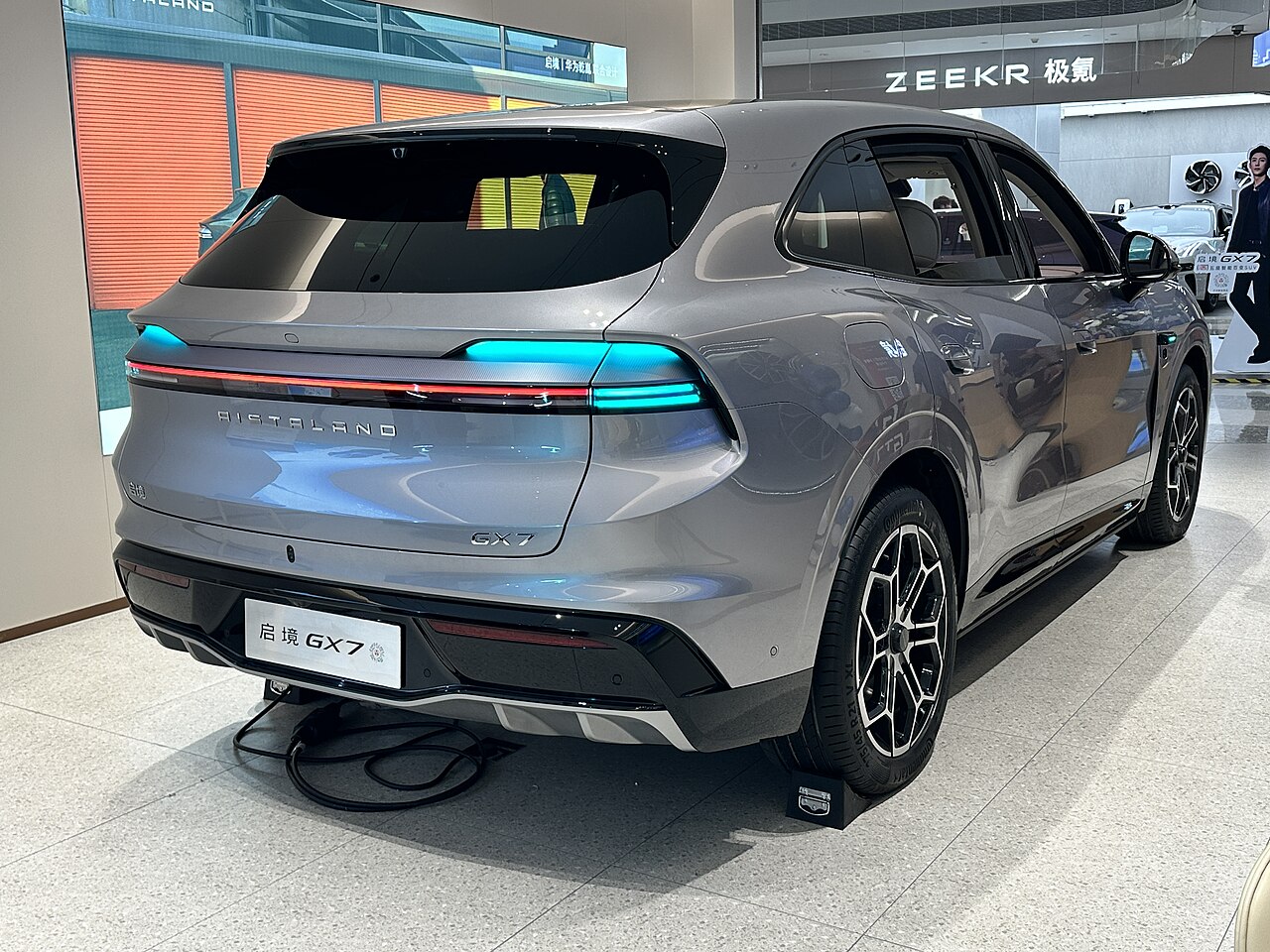
Qijing, the brand GAC is building with Huawei's Qiankun team, began taking pre-orders for its second model on September 3, offering three versions of the GX7 at 249,900 to 311,900 yuan. While the earlier GT7 chased young buyers with driving dynamics, the GX7 is a large five-seat extended-range SUV aimed at families, placing it in the crowded segment occupied by the Li Auto L8 and AITO M7.
Its signature feature sits in the back: engineers slimmed down the wheel-arch intrusions so the seatbacks fold completely flat in roughly 20 seconds, and at 2,006mm wide with the longest wheelbase of the three rivals, the GX7 claims more usable space than either competitor. The flat-bed mode is wired into HarmonyOS Cockpit 6 rather than being a simple lever trick — a CO2 sensor governs air recirculation to balance air quality against energy use, the system briefly cuts to internal circulation and boosts fan speed when the range extender fires up so its noise stays out of the cabin, and a battery floor automatically blocks or aborts the rest mode to prevent a dead pack.
The deeper moat, the author argues, is Huawei's Qiankun ADS 5 running on a four-lidar array that pairs an 896-line unit with solid-state dToF blind-spot radar. Huawei has been rolling out its newest technology on Qijing models first, and ADS 5 has been scoring at or near the top of d1ev's assisted-driving ladder rankings.
Market conditions look favorable: five Huawei-powered models each topped 5,000 units in July retail sales. The biggest threat is the Li Auto L8, which sold 6,210 units that month and is gaining ground as its own driver assistance improves. The GX7 counters with an 800V architecture and a tri-motor setup rated at 550kW — 130kW and 158kW more than the L8 and M7 respectively — leaving the final list price to decide whether it can reshuffle the family-SUV hierarchy.
This is an original summary compiled and translated from the source below, not a direct translation of it.
🔗 Source: 第一电动网 →