Postwar West Germany offered its citizens few routes into car ownership: with the economy in ruins and millions of working-age men dead or held in captivity, an automobile was a luxury beyond ordinary reach. That gap attracted an unlikely group of manufacturers. Forbidden from building aircraft, designers Ernst Heinkel, Willy Messerschmitt and Claude Dornier each turned to microcars — and Heinkel, whose Rostock plant had ended up in the Soviet zone, had resettled in Stuttgart and was even making bicycles to get by.
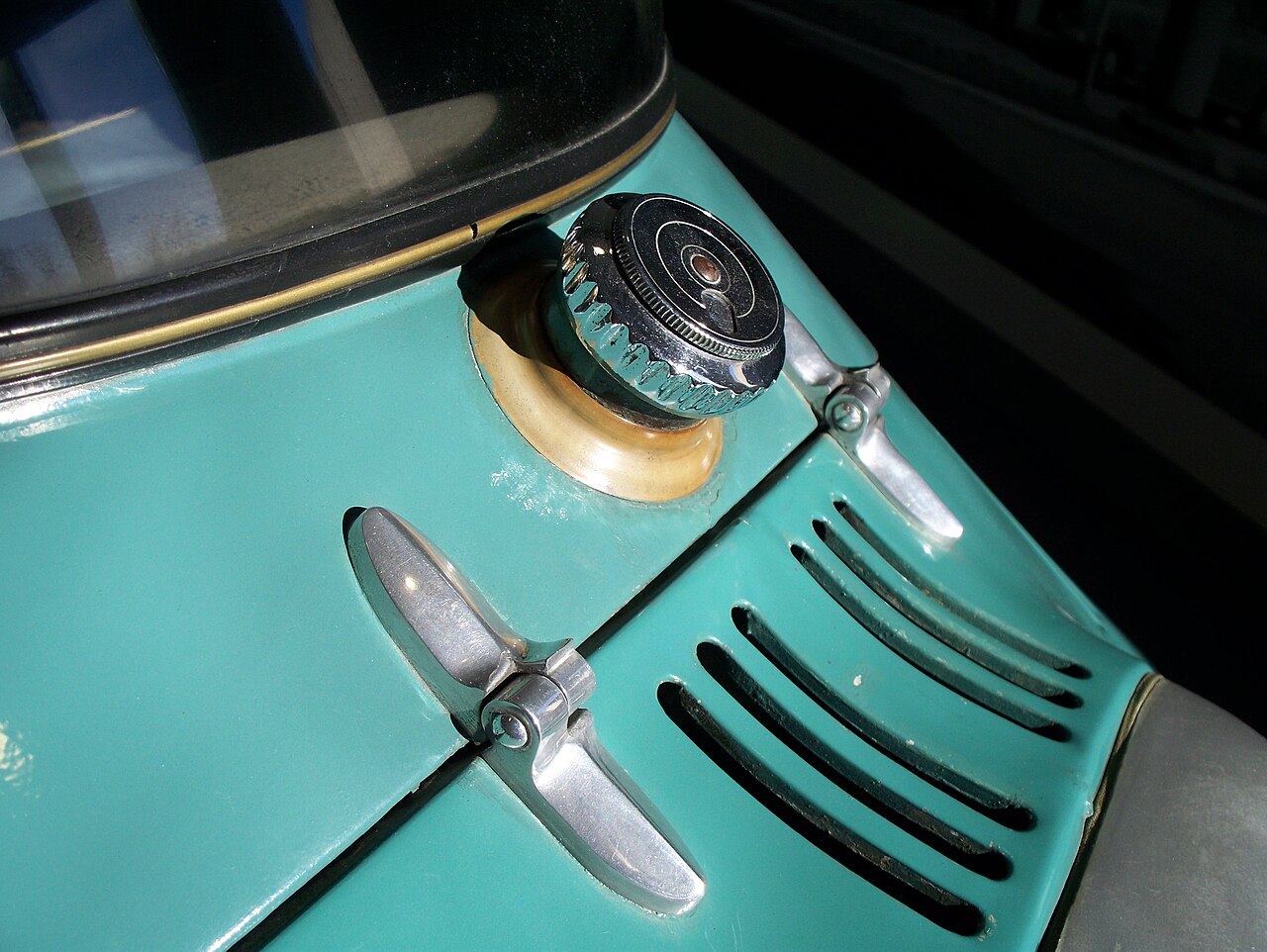
His answer arrived in 1956 as the Heinkel Kabine, a machine occupants entered by tilting forward the entire front of the body, steering column attached — a layout no modern safety authority would approve. The three-wheeled Type 153 and four-wheeled Type 154 sent power from a rear-mounted single cylinder to the back, with displacements of 0.17 or 0.2 liters and outputs of just 9.2 or 10.1 horsepower feeding a four-speed manual. Measuring 2.55 meters long and weighing between 475 and 510 kilograms, it sat somewhere between a scooter and a proper car.
Cheap as it was, the Kabine traveled far: Dundalk built it under license in Ireland until quality problems cost that firm the deal, while London's Trojan Cars kept production running until 1966 — well after German output began tapering off from 1958. From 1959, Argentina's Los Cedros assembled close to three thousand units. By then, though, a wave of genuine compact cars had swept Europe, and the microcar era was drawing to a close.