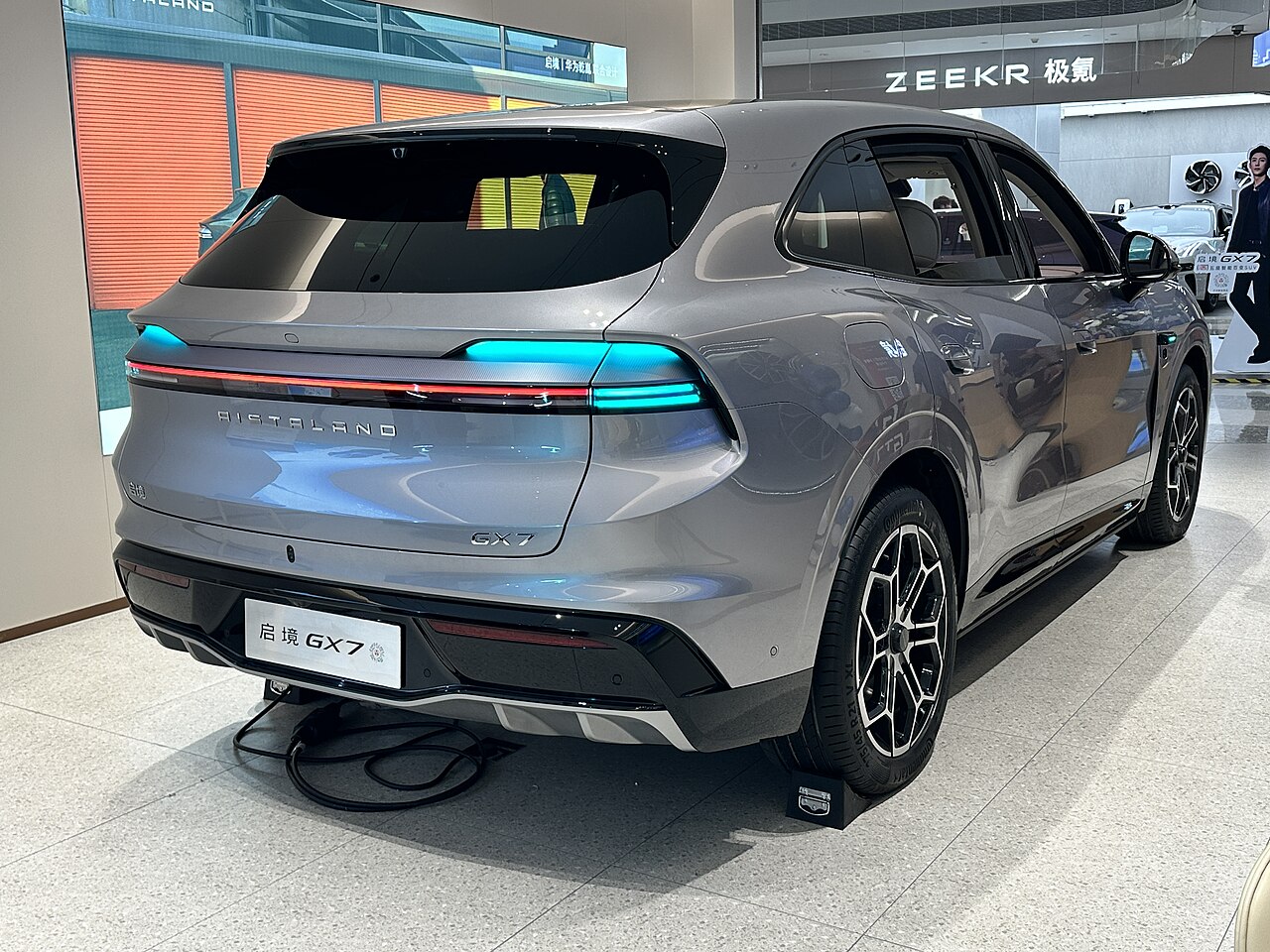
Aistaland, the car brand GAC Group and Huawei built together, has scheduled the official launch of its GX7 extended-range SUV for September 23, with customer handovers beginning the same day. The five-seater entered pre-sale on September 4 at 249,900 to 311,900 yuan and, per the company, drew over 20,000 orders within just 18 hours.
As the brand's second product — and its first move out of the shooting-brake niche into the far larger family-SUV market — the GX7 comes in three versions: a rear-drive Ultra at 249,900 yuan, a dual-motor AWD at 269,900 yuan, and a 311,900-yuan tri-motor flagship on an 800-volt platform. That top variant makes 550 kW, goes from 0 to 100 km/h in 3.9 seconds and supports 5C charging that restores 30–80% in about ten minutes. CATL supplies the batteries across the lineup, which offers 325–385 km of CLTC electric range and roughly 1,500–1,580 km combined.
Driver assistance comes from Huawei's Qiankun ADS 5, fed by 38 sensors including four LiDARs — among them an 896-line dual-optical-path unit — and Aistaland bills the GX7 as the only vehicle in its class built on an architecture designed for Level 3 autonomy, with redundancy spanning steering, braking, power supply, computing and other systems. Inside, the cabin runs HarmonySpace 6 with twin 15.6-inch screens and an 88-inch AR head-up display, and the second row folds into a fully flat bed in 20 seconds.
The stakes are considerable. The GT7, Aistaland's first model launched June 26, sold 2,658 units in July before sliding 58.62% month-on-month to 1,100 in August. Squaring off against rivals like the Aito M7, Li Auto L6 and Xiaomi YU7 in a much bigger segment, the GX7 is seen as pivotal to the brand's prospects for meaningful volume growth.